


With customers entering stores pre-informed and decision-ready, jewellery retailers are witnessing a shift in conversion dynamics, making in-store experience design a critical factor in influencing final purchase outcomes.
A well-located showroom with decades of trust and a strong bridal inventory recently experienced one of its highest footfalls during a peak wedding weekend. Serious buyers walked in — families with clear intent. Conversations were detailed, selections were made, and multiple pieces were shortlisted.
Yet, by the end of the day, conversions did not reflect the opportunity.
The retailer did not attribute this to pricing, product gaps, or negotiation challenges. Instead, what stood out was a more subtle shift. Customers were not rejecting products — they were hesitating. And this transition from rejection to hesitation is increasingly where modern jewellery retail is being won or lost.
Traditionally, conversion challenges were assessed at the point of sale — through pricing strategies, product mix, or sales effectiveness. Today, however, conversion is no longer decided at the billing counter.
It is determined across the entire in-store journey.
By the time customers enter a showroom, key decisions have already been shaped. They have researched designs and pricing benchmarks, formed a mental shortlist, and established a comfort range.
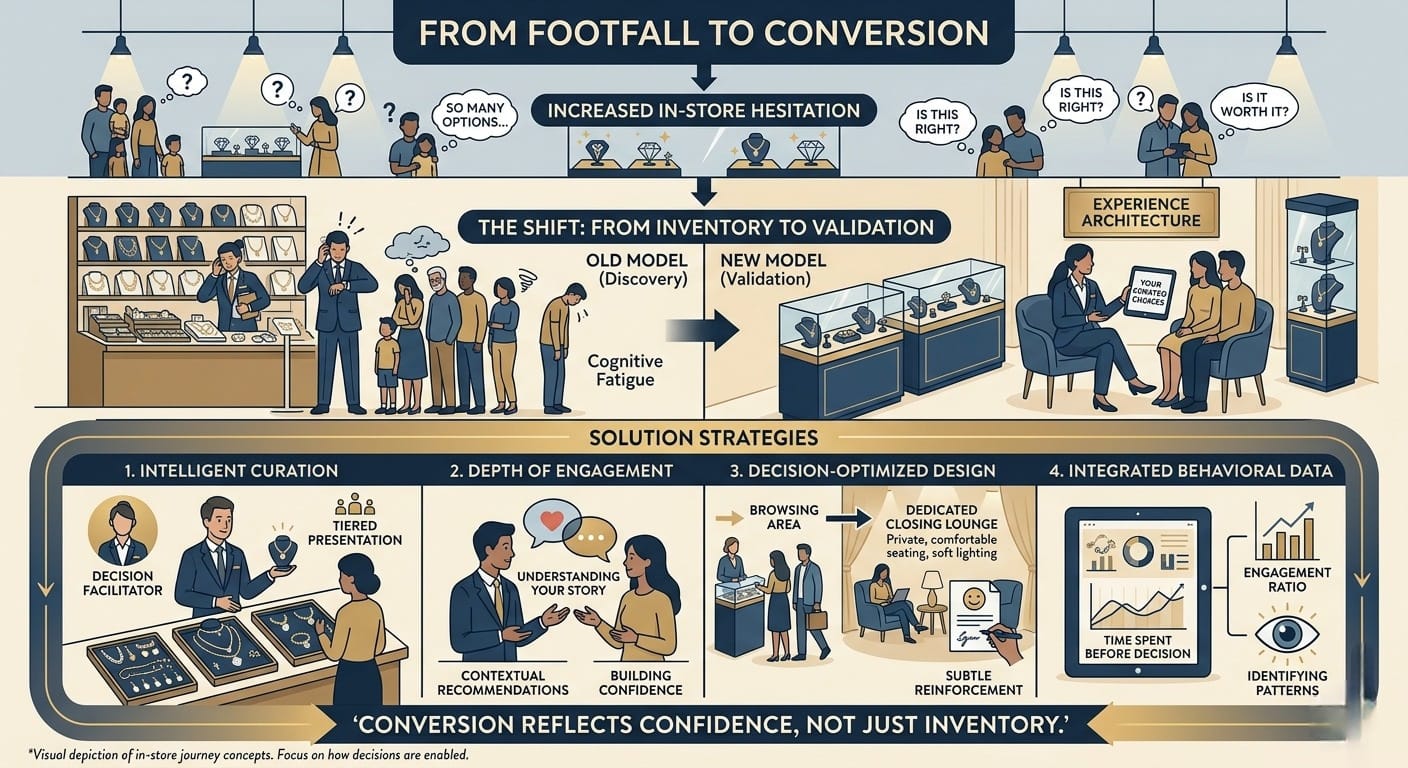
This fundamentally changes the role of the showroom. It is no longer a discovery space — it is a validation environment. And validation today is driven less by inventory and more by how effectively the experience is structured.
The challenge is not capability, but alignment. Many established retailers continue to operate with models designed for an earlier generation of consumers, leading to structural gaps that are not immediately visible.
Large inventories, once a competitive advantage, can now create cognitive fatigue if not curated effectively. Too many options delay decision-making rather than accelerate it. The issue is not assortment, but presentation logic.
Efficient sales teams are well-equipped to handle volume, but modern consumers require deeper engagement. Confidence is built through contextual understanding, relevant recommendations, and clarity in communication — factors that go beyond transactional selling.
In many stores, customer experience still varies depending on the salesperson. While one interaction may lead to conversion, another may fall short. This inconsistency can dilute overall brand trust and impact outcomes.
Conversion today is influenced by small but critical factors — unstructured waiting time, lack of continuity, physical fatigue during long purchase journeys, and absence of reassurance at key decision moments. These are not operational errors, but gaps in experience design.
To address these challenges, in-store experience must be treated as a structured and measurable system, rather than an intangible layer.
At a high level, the in-store journey operates across three interconnected layers:
Conversion occurs when all three layers are aligned.
The focus must shift from showing more to showing right. This involves early understanding of customer intent, tiered presentation of options, and structured storytelling around collections. Curation enables decision-making rather than limiting choice.
Sales interactions must evolve from product explanation to decision guidance. This includes leading with context, translating product features into personal relevance, and addressing decision anxiety — not just objections.
Retailers need to build consistent frameworks for customer interaction while allowing room for personalization. This ensures a uniformly high-quality experience across all touchpoints.
While most showrooms are optimized for showcasing, fewer are designed for closing. Dedicated spaces for high-value purchases, seamless transitions from browsing to decision-making, and reinforcement cues at critical moments can significantly impact conversion.
Tracking metrics such as footfall-to-engagement ratios, engagement-to-conversion rates, and time spent before decision-making can help identify patterns and refine strategies.
Shifting incentives from sales volume to conversion efficiency, customer satisfaction, and repeat engagement can drive more sustainable business outcomes.
In a market where designs can be replicated, pricing can be matched, and inventory can be sourced efficiently, competitive advantages are becoming increasingly short-lived.
What remains difficult to replicate is a well-orchestrated in-store experience.
This is where differentiation is shifting — not in what is sold, but in how the purchase decision is enabled.
For jewellery retailers, the focus is no longer solely on attracting footfall, but on converting intent into commitment.
Footfall indicates interest. Conversion reflects confidence.
And confidence is built not just through product or pricing, but through a carefully designed, consistently delivered, and strategically managed in-store experience.
At the highest level of retail performance, conversion is no longer an outcome — it is a system.








Be the first to comment