


Changing consumer behaviour, rising gold prices and faster buying cycles are driving demand for lightweight, high-rotation jewellery, forcing retailers to rethink inventory planning, merchandising strategies and sales approaches.
For decades, jewellery retail operated on a steady and predictable model. Heavy gold jewellery, bridal collections, and occasion-driven purchases formed the core of revenue. Inventory turnover was slow, customer visits were infrequent but high-value, and success was measured largely in grams sold and purity maintained.
That model has not disappeared — but it has permanently expanded.
Lightweight, high-rotation jewellery has emerged as a critical second engine of growth. This shift reflects a structural change in consumer behaviour, retail economics, and the pace at which jewellery is now purchased and worn. For experienced retailers, understanding this category is essential to protecting margins, improving cash flow, and maintaining market relevance.
Jewellery is no longer viewed solely as ceremonial or investment-driven. It has increasingly become part of daily lifestyle.
Key behavioural shifts include:
Preference for jewellery that is lightweight, comfortable, and suitable for everyday wear
Greater price sensitivity and budget flexibility due to rising gold rates
Demand for variety and frequent design refreshes
Increased purchase frequency, even with smaller ticket sizes
This demand is no longer confined to younger consumers. Working professionals, repeat bridal buyers, and mature customers are also incorporating lightweight jewellery into their regular purchase cycles.
Lightweight jewellery is often defined purely by gram value, but its defining characteristic is inventory behaviour.
High-rotation jewellery typically:
Sells faster than traditional categories
Requires more frequent replenishment
Has shorter design relevance cycles
Depends heavily on styling and presentation
This shifts jewellery from a slow-moving asset into a dynamic retail category requiring active management.
The rise of high-rotation jewellery significantly alters business economics.
Inventory velocity improves, strengthening cash flow and reducing holding periods. However, forecasting risks increase, as designs can lose relevance quickly and become slow-moving stock.
At the same time:
Average bill values decline
Transaction volumes increase
Profitability depends on sell-through speed and repeat visits
Retailers must also adapt to shorter design lifecycles. Designs that once remained relevant for years may now peak within a single season, requiring faster decision-making.
Higher rotation introduces operational complexity.
Retailers commonly face:
Significant increase in SKU count
More frequent stock movement
Greater dependence on accurate inventory tracking
Increased coordination with suppliers and manufacturers
Without disciplined inventory management, inefficiencies can gradually erode margins.
Despite strong demand, retailers report several recurring issues:
Difficulty predicting sustained demand for trend-driven designs
Working capital locked in slow-moving inventory
Sales teams relying on traditional weight-based selling approaches
Store displays appearing unchanged to repeat customers
These challenges reflect the faster pace of modern jewellery consumption rather than lack of retail experience.
Retailers adapting successfully are restructuring inventory and buying strategies around speed and flexibility.
Key approaches include:
Segmenting inventory into fast-moving, seasonal, and evergreen categories
Introducing new designs in smaller quantities and scaling proven performers
Establishing clear exit timelines for slow-moving products
Creating collections that support stacking, layering, and repeat purchases
This approach enables retailers to capture demand while limiting capital exposure.
Visual freshness has become essential in driving engagement.
Effective merchandising practices include:
Frequent re-merchandising of existing stock
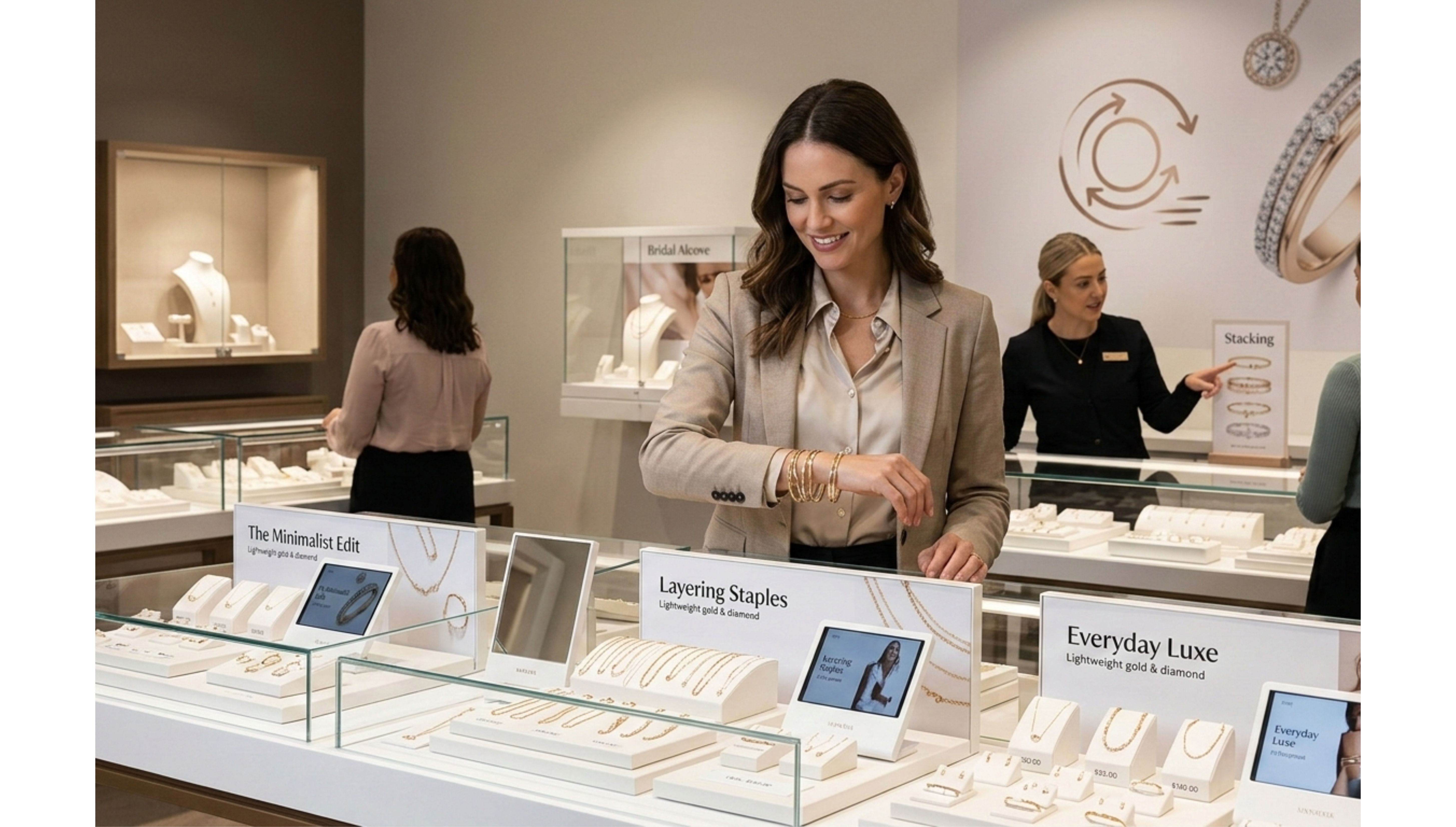
Thematic displays such as Everyday Gold, Office Wear, and Daily Essentials
Highlighting newness through presentation and storytelling
This creates the perception of freshness without excessive inventory expansion.
Sales strategies are also evolving in response to lightweight jewellery demand.
Effective sales teams:
Emphasise comfort and wearability
Recommend styling combinations and complementary pieces
Encourage repeat purchases and collection-building
This positions sales professionals as advisors, improving conversion and customer retention.
Lightweight jewellery complements rather than replaces traditional heavy jewellery.
In a balanced retail model:
Lightweight jewellery drives frequency and repeat visits
Heavy jewellery reinforces trust and milestone purchases
Together, they stabilise revenue across buying cycles
Retailers who focus exclusively on one category risk losing either relevance or heritage value.
The rise of lightweight, high-rotation jewellery reflects a faster retail cycle rather than a departure from traditional retail principles.
Trust, craftsmanship, and reputation remain fundamental. However, success increasingly depends on agility, inventory discipline, and responsiveness to evolving consumer behaviour.
Retailers who align buying, merchandising, and selling strategies with this shift will strengthen cash flow, improve inventory efficiency, and enhance long-term customer engagement.
In the modern jewellery market, success is defined not only by weight—but by how efficiently jewellery moves and how consistently customers return.



Be the first to comment