


Jewellery retailers across India face rising dead inventory levels, with 30–40% unsold stock locking capital, driven by changing consumer preferences, rising gold prices, and slower movement of traditional designs.
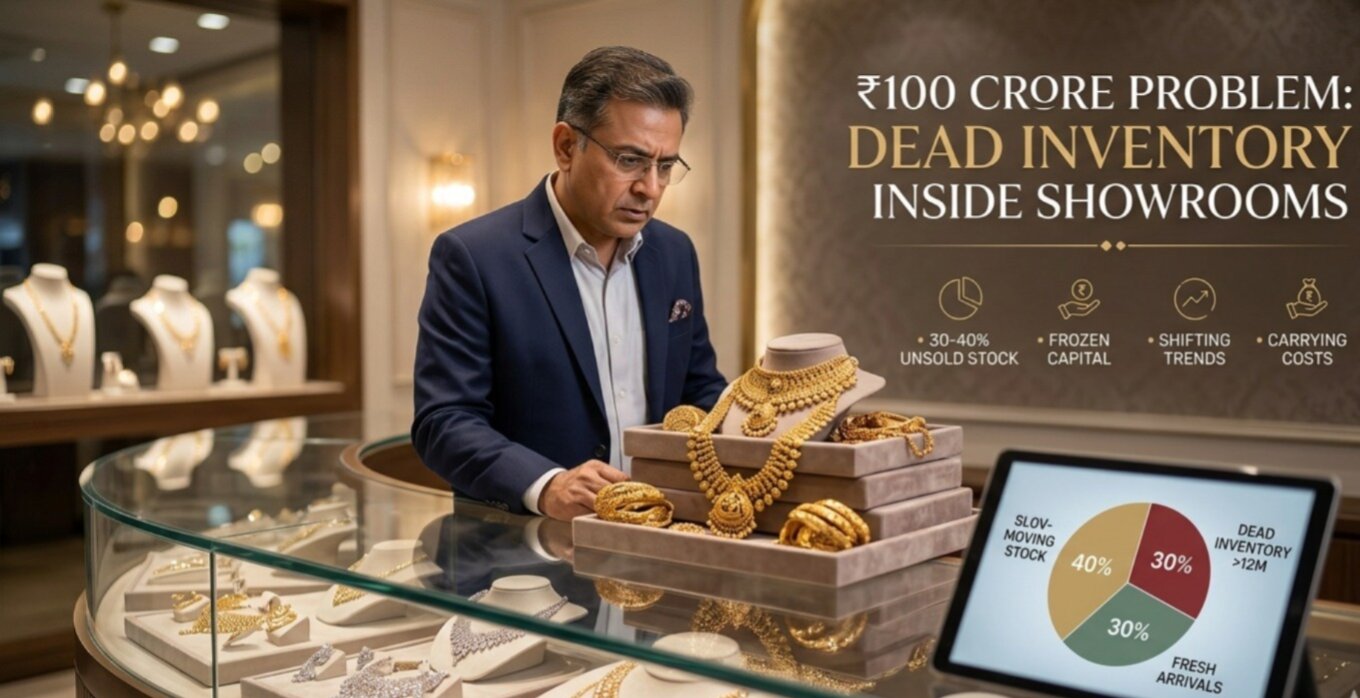
Across India’s jewellery retail sector, a significant portion of showroom inventory remains unsold for extended periods, quietly locking up substantial capital and impacting overall business efficiency.
On the surface, most jewellery stores project abundance — fully stocked showcases, elaborate bridal sets, and neatly displayed diamond collections. However, behind this presentation lies a growing concern: an estimated 30-40% of inventory in many stores has not moved for over a year, with some pieces ageing beyond two to three years.
Dead inventory goes beyond simply being old stock. It refers to jewellery that has remained unsold for extended periods and is increasingly unlikely to sell without strategic intervention from the retailer.
Typically, inventory begins to fall into this category after 12 to 18 months of inactivity, with pieces crossing the 24-month mark becoming even harder to liquidate. Unlike other retail sectors, jewellers cannot rely heavily on discounting due to the intrinsic value of gold, diamonds, and craftsmanship, which directly impacts margins.
One of the primary drivers of rising dead inventory is the rapid evolution of consumer preferences. Influenced by social media, global exposure, and celebrity trends, customers today are moving towards lightweight, minimal, and versatile jewellery, reducing demand for heavier traditional designs.
At the same time, design overlap across retailers — often sourcing from the same manufacturers and trade exhibitions — has reduced differentiation in the market. This leads to increased comparison, delayed purchasing decisions, and greater price sensitivity, ultimately slowing inventory turnover.
The impact of dead inventory is not limited to sales performance; it has significant financial implications. In a showroom with inventory worth Rs 250 crore, even a 40% stagnation translates to Rs 100 crore in blocked capital that is not generating returns.
This capital blockage restricts a retailer’s ability to invest in new designs, marketing initiatives, store expansion, or digital transformation. In addition, unsold jewellery continues to incur costs such as insurance, security, storage, and showroom space, further adding to operational pressure.
Dead inventory also affects the overall showroom experience. Customers today expect novelty and frequent refreshes in collections, and static displays can reduce engagement over time.
A lack of newness can lead to fewer repeat visits, reduced impulse purchases, and lower excitement during key buying occasions such as bridal shopping. In contrast, retailers who consistently refresh their offerings are more likely to create a sense of discovery and drive footfall.
Forward-looking jewellers are increasingly treating inventory as a dynamic investment rather than static stock. This involves regularly evaluating fast- and slow-moving designs, identifying declining categories, and making timely decisions to optimise stock performance.
The focus is shifting from holding large volumes of inventory to managing it efficiently. Retailers are recognising that success lies not in the quantity of stock held, but in how effectively it is rotated and monetised over time.
To address the challenge, retailers are adopting more proactive strategies. Regular inventory audits help identify slow-moving stock early, enabling timely action such as redesign, recycling, or repositioning of products.
Other approaches include planned clearance events, data-driven buying with smaller test batches, and a stronger focus on lightweight jewellery that offers faster turnover. Training sales teams to promote older inventory alongside new collections is also emerging as a practical solution.
As the jewellery retail landscape evolves, inventory management is becoming a critical differentiator. The industry is gradually moving towards more data-driven, agile approaches, where capital efficiency and stock rotation play a central role in profitability.
For many retailers, the challenge is not a shortage of jewellery, but the need to unlock value from existing stock. How effectively they address this issue will define their competitiveness in an increasingly dynamic market.







Be the first to comment