


India's listed jewellers have posted their best March quarter on record. Strip out a 79% rise in the gold price, and a quieter, more uncomfortable picture emerges — one the unorganized trade and several regional listings have already started to live with.
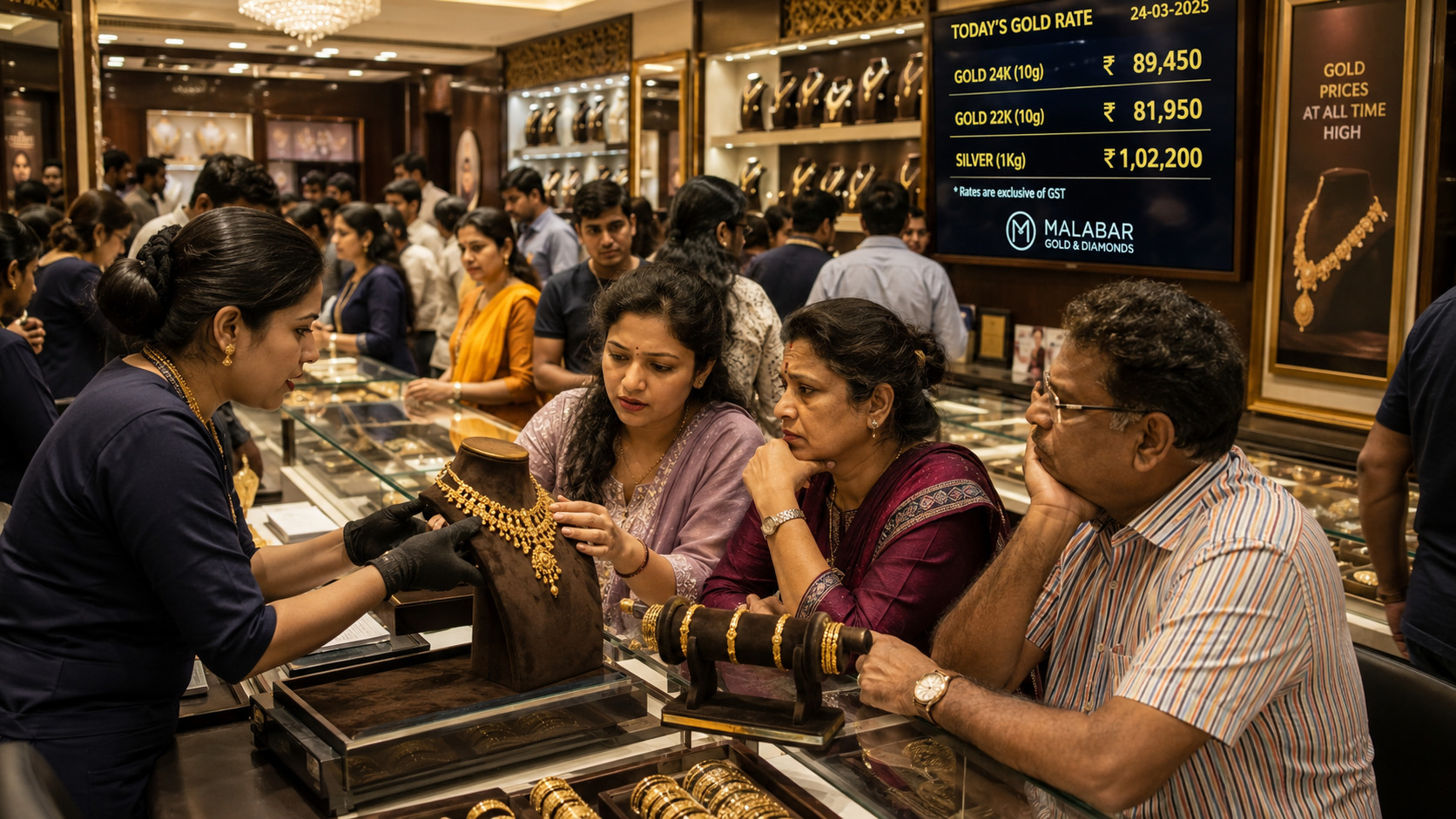
By the time Titan's Q4 FY26 results hit the wires this week, the headline reads were already familiar. PNG Jewellers up 124%. Kalyan Jewellers up 64%. Senco Gold up 46%. Titan up 46%. PC Jeweller up 32%. Nine months ago, this sector was the market's punching bag. Today it is, by every reported metric, on fire.
There is just one problem with the story: most of the fire is gold.
The 79% question
Between Q4 FY25 and Q4 FY26, the average price of gold moved from roughly Rs 84,800 per 10 grams to Rs 1,51,800. That is a 79% year-on-year jump — and the price climbed another 20% sequentially from Q3 FY26. Senco Gold disclosed those exact numbers to investors. Every listed jeweller is selling into the same metal market.
If a retailer's revenue grew slower than 79%, that retailer almost certainly sold less gold by weight than it did a year earlier. By that arithmetic, only PNG Jewellers — at +124% — clearly sold more grams in Q4. Kalyan was just under the line on a consolidated basis, with India operations growing about 65%. Titan, Senco, and PC Jeweller all printed revenue growth below the rise in the metal itself.
Senco's management has been the most candid in spelling out what this means. For FY25, the company reported roughly 40% value growth against an estimated 10% drop in volume. The grams left the building; the rupees didn't.
Buyers didn't double. Tickets did.
Titan, the country's largest organized jeweller, made the same admission in a different language. In its pre-quarter update, the company said jewellery buyer growth turned "high-single-digit" in Q4 FY26 — after nearly flat buyer growth across the first three quarters of the year. So a business whose total jewellery revenue grew 50% in Q4 added customers in the high single digits. The math only works one way: existing customers paid considerably more for the same or less metal. Titan itself acknowledged that rising gold prices pushed up average ticket sizes while footfall growth remained marginal.
This is a price-led market masquerading as a volume-led one. And the distinction matters enormously, because price-led growth carries none of the operating leverage that volume-led growth does.
The canary nobody is looking at
While the big chains absorbed the gold rally with the help of bank-backed metal loans, hedging desks, and FOCO expansion firepower, the early signs of what happens without those buffers were already visible in the regional listings — and the clearest signal came from Vizag-based Manoj Vaibhav Gems N Jewellers, the company that operates the Vaibhav Jewellers brand across Andhra Pradesh and Telangana.
In Q1 FY26, with gold prices already running materially above year-ago levels, Manoj Vaibhav reported standalone revenue of just Rs 550 crore — up only 1.4% year-on-year. Profit after tax fell 5.4% to Rs 20.6 crore. For nine months of FY26, the company reported revenue of Rs 1,994 crore and PAT of Rs 87 crore, with profitability moving in the wrong direction even as the gold rally lifted everyone else's topline.
This is the canary in the coal mine. In an environment where input prices were rising sharply, flat revenue at a retailer means volume contracted sharply. The market has already returned its verdict — the stock is down nearly 30% over the past 12 months, and trades at a P/E of around 7.6x against Titan's 75x-plus.
What is happening to Manoj Vaibhav is not a company-specific story. It is what happens to a regional Tier-2 and Tier-3 retailer when the FOCO rollouts of Kalyan, PNG, and Tanishq's expansion machinery arrive in their backyard at the same time gold prices are eating into walk-in budgets. There are several hundred unorganized retailers across the country going through the same squeeze; most of them are not listed, so the data is invisible. Manoj Vaibhav is one of the few places where it shows up on a balance sheet.
The studded paradox
The premiumisation thesis the listed sector has sold investors for half a decade — that Indians are trading up from plain gold to higher-margin studded jewellery — looks shaky in this print.
Titan reported Q4 studded growth of about 35%, helped by its "Festival of Diamonds" campaign. On paper that's robust; in context, it merely matched plain gold's growth. Plain gold, exchange programmes, and gold coins absorbed the bulk of Q4 demand. The Tanishq jewellery EBIT margin contracted to 12.1% in the quarter, with the company explicitly attributing the squeeze to a mix shift toward coins and exchanges and away from high-margin studded pieces.
Senco told investors something similar earlier in FY26: silver and lightweight categories grew faster than diamonds across several quarters. The studded mix is not collapsing — but it is no longer outrunning the rest of the basket the way the equity story requires.
Where the margin really went
The market saw this in Titan's number. Consolidated profit grew 35% to Rs 1,179 crore against revenue growth of 46% — the kind of gap that signals operating costs running ahead of topline. The company's total expenses rose 85% in the quarter, weighed down by raw material inflation, advertising spend tied to the Damas integration, and promotional costs needed to keep ticket inflation from killing footfall outright.
Kalyan's standalone India PAT grew 97% on a 68% revenue base — better operating leverage, but materially helped by an aggressive franchise-owned-company-operated (FOCO) expansion that decouples revenue from owned capex. PC Jeweller, still in turnaround, paired its 32% Q4 growth with a 23% reduction in outstanding bank debt; the headline here is balance-sheet repair, not operational momentum.
The pattern across the sector is a topline that looks sharper than the bottom line because gold price inflation is a one-for-one revenue boost and a less-than-one-for-one margin event.
What this says about the trade the listed names leave out
Five listed jewellers control a fast-growing slice of the Indian market — but the market itself remains overwhelmingly unorganized. For the family jeweller in a Tier-2 town, none of the FY26 mechanics that protected the big chains are available. They cannot lease gold from banks at single-digit costs to neutralise price risk. They cannot hedge 50–60% of inventory the way Senco does. They cannot fund a 79%-pricier inventory through equity raises or warrant conversions. They cannot offset volume contraction with a 170-store FOCO rollout the way Kalyan can.
What they can do is shrink. Carry less depth. Hold lighter ranges. Push exchange programs harder. Quietly lose share to the chains rolling into their high streets — share that, on the listed side, gets reported as same-store-sales growth.
That is the quiet story buried inside Q4 FY26. The chains are not winning a volume war; they are winning the price-led restructuring of an industry where the metal has run faster than the buyer.
Still to watch
A complete read on the quarter has to wait for two more sets of numbers. Both are due in the next few weeks.
Thangamayil Jewellery, the Madurai-headquartered chain that has had a strong run in FY26, is expected to declare Q4 results later in May. The company's Q2 FY26 print was an outlier — revenue up nearly 45% year-on-year, with profit swinging from a loss to Rs 58.5 crore — but its structural margin profile of 6–7% reflects the tighter operating economics of the hyper-competitive South India market.
Manoj Vaibhav Gems N Jewellers is yet to declare Q4 FY26 numbers. Given the Q1–Q3 trajectory, the print will be a useful test of whether the company has stabilised its volume base in the bridal-heavy March quarter or whether the share migration to organized chains has continued.
When those numbers land, the picture will be complete. The thesis, however, is not likely to shift.
The takeaway
The listed jewellery sector printed its best Q4 ever, by rupee. By gram, FY26 will likely go down as a year of contraction across most of the trade. The two facts are not contradictory; they are the same fact, viewed from two ends of the value chain.
If gold cools off in FY27, the topline tailwind disappears. If it doesn't, the gap between organized and unorganized players will keep widening — not because the chains are growing faster, but because everyone else is running out of working capital.
Either way, the next quarter's earnings calls deserve a different question. Forget revenue growth. Ask the management one thing: how many grams did you sell?




Be the first to comment