


As jewellery consumers become more informed and cautious, retailers are increasingly facing delayed purchase decisions driven by friction in trust, storytelling, pricing clarity, customer engagement, and overall buying experience.
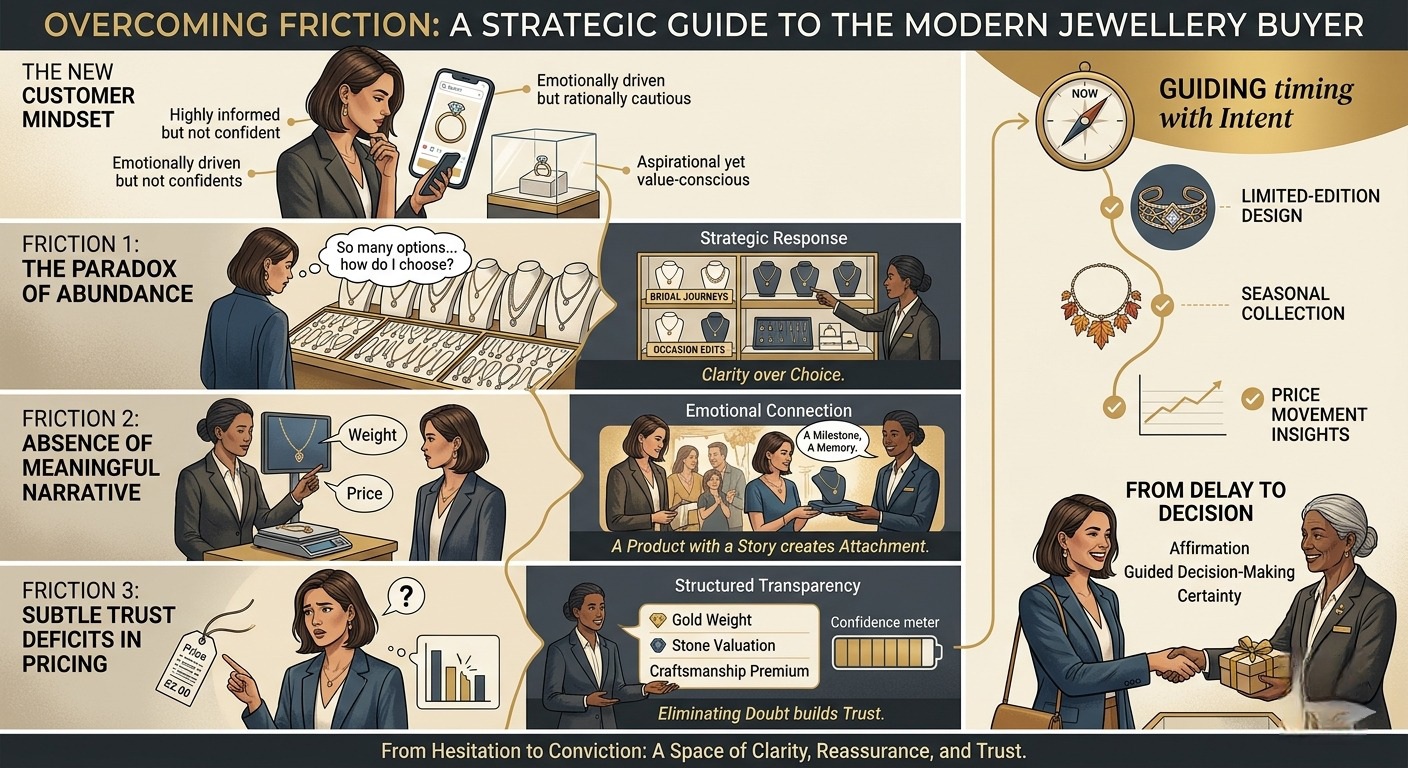
On a late evening in a flagship showroom, a seasoned retailer observed something familiar yet deeply concerning. A well-informed client — someone who had clearly done their research spent over an hour evaluating a diamond necklace. She asked the right questions, compared designs, even visualised how it would pair with her upcoming event wardrobe.
Everything indicated intent.
Yet, as she prepared to leave, she paused and said, “I’ll take a day to think about it.”
No objection. No negotiation. No dissatisfaction.
Just… delay.
For today’s jewellery retailer, this is not an isolated moment — it is a pattern. Across categories, cities, and customer segments, purchase decisions are increasingly being postponed, even when desire and affordability are not in question.
The instinctive response is to attribute this to market conditions, pricing pressures, or increased competition. However, the more critical and often overlooked — reality is this:
Customers are not delaying because they are unwilling to buy. They are delaying because something in the buying journey is creating friction.
And these frictions are rarely obvious.
The modern jewellery buyer operates very differently from a decade ago. Access to information, exposure to global design sensibilities, and heightened financial awareness have fundamentally reshaped decision-making.
Today’s customer is:
This duality creates a delicate balance. The desire to own is strong — but so is the need to feel certain.
In this environment, even a subtle gap in clarity, trust, or reassurance can lead to hesitation.
Jewellery retail has long equated variety with strength. Larger inventories, wider design ranges, and extensive display counters are seen as competitive advantages.
In reality, this abundance often works against conversion.
When a customer is presented with too many options without structured guidance, the experience shifts from excitement to cognitive overload. Instead of moving closer to a decision, the customer becomes increasingly unsure.
The consequence is not rejection — but deferral.
Strategic Response:
In a premium retail environment, clarity is more valuable than choice.
Jewellery is inherently emotional, yet much of its selling remains transactional — focused on weight, price, and making charges.
While these parameters are important, they are insufficient to drive conviction.
A customer does not merely buy a necklace; she buys:
When this narrative is missing, the purchase becomes a financial evaluation rather than an emotional commitment.
Strategic Response:
A product without a story invites comparison.
A product with a story creates attachment.
Even in established showrooms, pricing remains one of the most sensitive friction points.
Not necessarily because prices are high — but because they are not always fully understood.
Ambiguity around:
can introduce hesitation, particularly among well-informed buyers.
In premium retail, perceived opacity is more damaging than actual cost.
Strategic Response:
Trust is not built by lowering prices.
It is built by eliminating doubt.
Jewellery is a high-involvement purchase with long-term implications. Unlike fast-moving luxury, it is expected to endure—across occasions, trends, and personal evolution.
Customers often hesitate due to internal questions:
This is not indecision. It is risk assessment.
Strategic Response:
Reducing perceived risk is one of the most powerful conversion tools.
In the absence of urgency, even a committed buyer will defer.
Jewellery purchases — unless tied to a fixed event — are inherently postponable. Without a clear trigger, the decision naturally shifts to “later.”
Strategic Response:
A refined retail experience does not push — but it guides timing with intent.
At its core, jewellery retail remains a relationship-driven business. The product may attract, but it is the interaction that converts.
Inconsistencies in staff capability — whether in product knowledge, communication style, or emotional intelligence — can significantly impact customer confidence.
A single misaligned interaction can interrupt an otherwise perfect buying journey.
Strategic Response:
In premium retail, the salesperson is not a facilitator — they are a curator of decisions.
One of the most overlooked gaps in jewellery retail is the absence of structured post-visit engagement.
A customer who leaves without purchasing is often still in the consideration phase. However, without timely and thoughtful follow-up, that intent dissipates.
Strategic Response:
Conversion does not always happen within the showroom.
But it rarely happens without continued engagement.
The modern buying journey begins long before the showroom visit.
Customers validate:
through digital platforms.
An inconsistent or underdeveloped digital presence introduces hesitation — even before the first interaction.
Strategic Response:
In today’s environment, digital presence is not marketing — it is pre-selling.
Contrary to assumption, many premium customers do not enter with rigid budgets. They operate within flexible ranges, adjusting based on perceived value.
However, when this range is not understood or guided effectively, the experience can create discomfort — either by overshooting expectations or failing to present meaningful options.
Strategic Response:
Clarity in financial alignment enhances confidence in decision-making.
Even when all parameters align — design, price, intent — many transactions fail at the final stage.
The reason is simple: the experience lacks a decisive closing moment.
There is no synthesis of the journey. No reinforcement of the choice.
In high-value retail, closure is not about persuasion.
It is about affirmation.
It is critical for retailers to reframe how they interpret delayed decisions.
A delay is not a lost sale.
It is a diagnostic signal.
It reveals:
Retailers who analyse these signals systematically and respond with precision — position themselves ahead of the market.
The future of jewellery retail will not be defined by inventory size or price competitiveness alone. It will be shaped by the ability to:
Customers are not looking for more options.
They are looking for certainty in the options they choose.
When a showroom evolves from being a place of selection to a space of clarity, reassurance, and guided decision-making, the shift is immediate:
From hesitation to conviction.
From delay to decision.
And ultimately, from browsing to buying.





Be the first to comment