
With new trade agreements opening markets, and shifting global sourcing strategies creating fresh opportunities, India’s gem and jewellery industry is entering an important phase. GJEPC Chairman Kirit Bhansali discusses India’s growing global role, emerging export opportunities, and the road ahead, with Suneeta Kaul.

Q: How transformative will the India-UK Free Trade Agreement be for India's gem and jewellery exports? Which product categories stand to benefit the most?
A: The India–UK FTA is genuinely transformative for India’s gem and jewellery exports. Zero-duty access to the UK’s $4bn jewellery market will improve India’s price competitiveness, and put Indian exporters on a stronger footing against international suppliers.
India’s gem and jewellery exports to the UK stood at around $754 million in the year 2025. With the significant tariff advantage, including zero-duty access for jewellery, we expect this to grow to nearly $2.5 billion within the next three years.
The opportunity is broad-based, but some categories are particularly well placed to benefit. Studded gold jewellery is likely to see the strongest gains, given the significant tariff advantage, and India’s strength in design-led and value-added jewellery manufacturing.
Silver jewellery is another important opportunity, where the combination of strong UK demand and improved price competitiveness can help Indian exporters expand their market share. Platinum jewellery, although a smaller segment, also has considerable potential, given its strong growth trajectory. Plain gold jewellery can benefit from the large and well-established South Asian diaspora market in the UK.
For cut and polished diamonds, the direct tariff benefit is relatively more moderate because these items were already duty free. However, the FTA strengthens the overall business environment, and makes India a more competitive and attractive sourcing destination for the UK.

Q: How should Indian exporters prepare to maximize the commercial opportunities created by duty-free access to the UK market?
Indian exporters already have a strong understanding of the UK market, and the opportunity now is to deepen that understanding further. The UK is a design-led, quality-conscious market, where ethical sourcing and responsible business practices are increasingly important. Exporters need to align their products, quality, provenance, and credentials with these evolving expectations, including recognized certifications, such as RJC, where relevant.
GJEPC is already helping exporters strengthen their engagement with the market through Buyer-Seller Meets, India Pavilions, and direct engagement with UK buyers. Our India–UK Buyer-Seller Meet in London, for instance, brought 20 Indian exhibitors together with more than 80 UK buyers. We will continue holding these meets, and help Indian exporters convert the new duty-free access into sustained business.
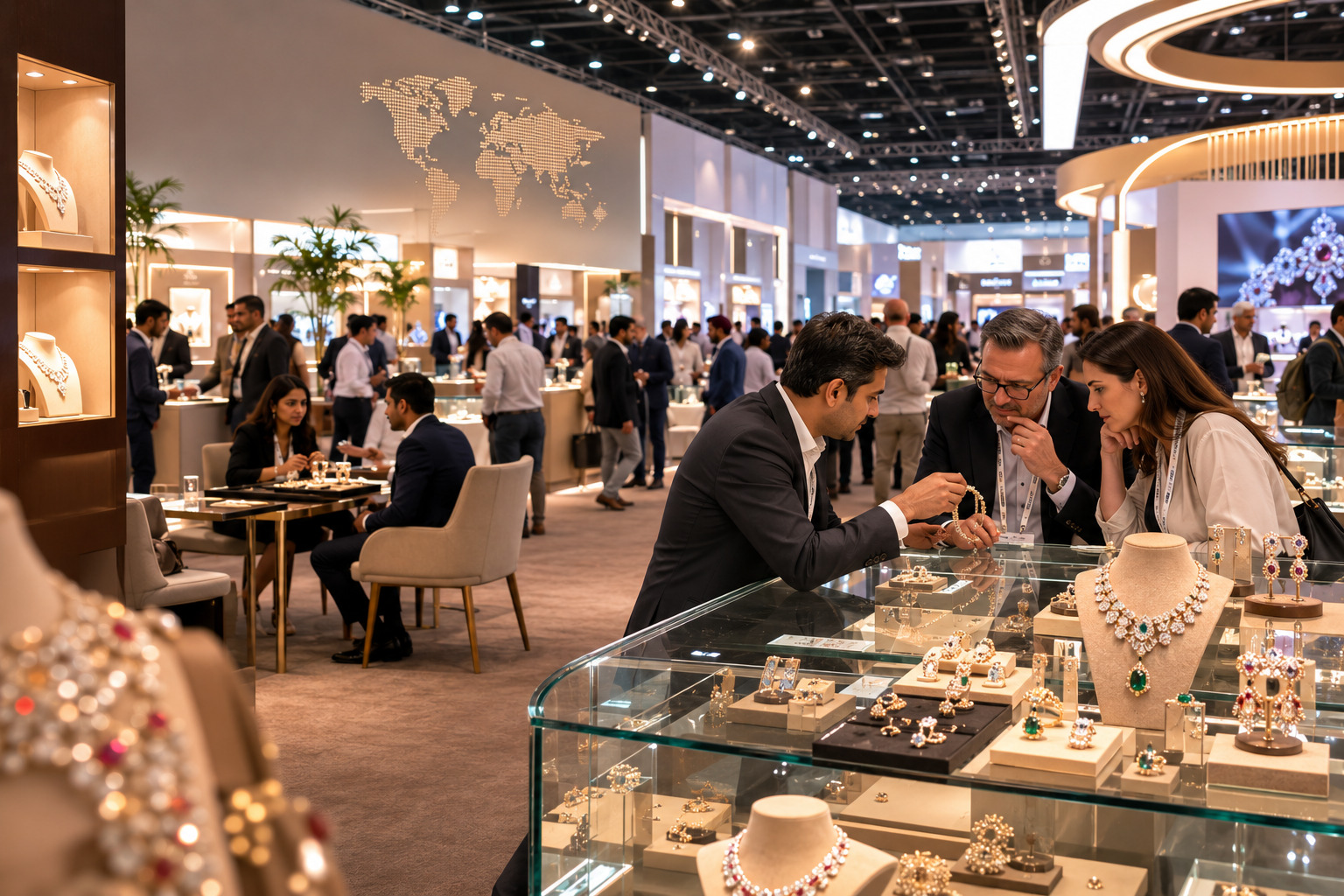
To fully leverage the opportunities created by the pact, GJEPC is also facilitating greater participation by Indian exporters at key UK trade platforms. The Jewellery Show London, scheduled for September 2 2026 and September 3 2026, is one such important opportunity.
We already have confirmations from 12 Indian exhibitors, and are working to further increase participation. With around 3,500 international trade visitors expected, the show will provide Indian exhibitors with an important platform to showcase their products, connect with buyers, and strengthen their presence in the UK market.

Q: India's gem and jewellery exports to the UAE have risen significantly, but how much of this increase can genuinely be attributed to CEPA, rather than gold prices, exchange rates, or broader market conditions?
A: CEPA has clearly contributed to this growth, although gold prices, currency movements, and broader market conditions have also influenced export values. What is encouraging is that the data points to a broader and more structural strengthening of the India–UAE trade relationship.
India’s gem and jewellery exports to the UAE grew at a 14.6% CAGR, from $5.77 billion in FY2022–23, to $8.69 billion in FY2025–26. The growth has been broad-based. Gold jewellery grew at over 21% CAGR to $5.64 billion, with studded gold jewellery outperforming plain gold jewellery, while coloured gemstones grew at an impressive 25.8% CAGR. Cut and polished diamond exports also remained resilient, growing at a CAGR of nearly 8%, despite challenges in the natural diamond market.
Perhaps the strongest evidence of a structural shift is that the UAE’s share of India’s total gem and jewellery exports nearly doubled to 30.7% from 15.15%. We have also seen 18 Indian exporters establish their own offices in Dubai after incubating at our IJEX centre. Companies make that kind of long-term investment when they view a market as strategically important, with easy access.

Q: GJEPC has established the India Jewellery Exposition Centre in Dubai to help Indian MSMEs access the regional market. How important is Dubai’s role as a re-export and trading hub?
A: Central — and often underestimated when people look only at bilateral figures. A significant share of what enters Dubai does not stay there; it moves on to Africa, the wider Gulf, the CIS region, and beyond. So, duty-free access to the UAE is not access to a single market of 10 million people. It is access to a distribution platform serving a far larger region.
That is why IJEX matters. It is not a showroom, but an incubator — in the past year, it onboarded 25 exporters, and facilitated over 457 buyer meetings with buyers from 14 countries. But the number I would point to is this: 18 exporters have gone on to open their own Dubai offices after starting at IJEX. Most are MSMEs who would never have attempted the Gulf on their own.

Q: How have changing tariff structures of the US, and the global 'China+1' strategy, altered sourcing decisions for international jewellery buyers? Can India realistically emerge as the world’s next major jewellery manufacturing hub, or will China, Thailand, and other established centres remain difficult to displace?
A: Let me take the second part first.
In diamonds, India is not emerging as the hub — India already is the hub. Fourteen out of 15 diamonds in the world are cut and polished here.
What is changing now is the trading side. Parliament has passed the Taxation and Other Laws (Amendment) Bill, 2026, providing a 15-year income-tax exemption on the sale of rough diamonds by eligible foreign companies through India’s Special Notified Zones. This is a reform GJEPC has advocated for over many years. It can encourage mining companies, sightholders, brokers, and auction houses to bring rough diamonds directly to India. That takes us from being where the world’s diamonds are made, to where they are also bought and sold — and for our manufacturers, it means greater access to rough diamonds at source.
When it comes to jewellery manufacturing, the picture is more competitive. China has real strengths in high-volume, machine-made production, and Thailand in silver and coloured gemstones. These are established centres, and will remain important.
But the sourcing calculus has moved in our favour. Post-Section 301, India sits in the 10% tariff band, while China, Hong Kong, Thailand, Türkiye, the UAE, Israel, and Vietnam are at 12.5%. India is, therefore, entering the world’s largest jewellery market on better tariff terms than several principal competitors. India is already the largest source of US jewellery imports, meeting around 16% of the market’s demand.
And China+1 is not about companies leaving China. It is about not depending on a single country. Buyers are looking to add a second source, and what they want is reliability — quality, consistency, IP protection, and a stable business environment. India scores well on these parameters. We are not asking buyers to replace their existing suppliers; we are asking them to make India their second source.
So, my assessment is straightforward: India will not displace China across every category, and that should not be the objective. But India can become the preferred destination for design-led, skill-intensive and higher-value jewellery — and in diamonds, we already hold that position.


Be the first to comment