


As jewellery buying shifts toward longer consideration cycles, retailers and manufacturers must reframe hesitation not as failure, but as a trust-led decision process shaped by permanence, complexity, and emotional alignment.
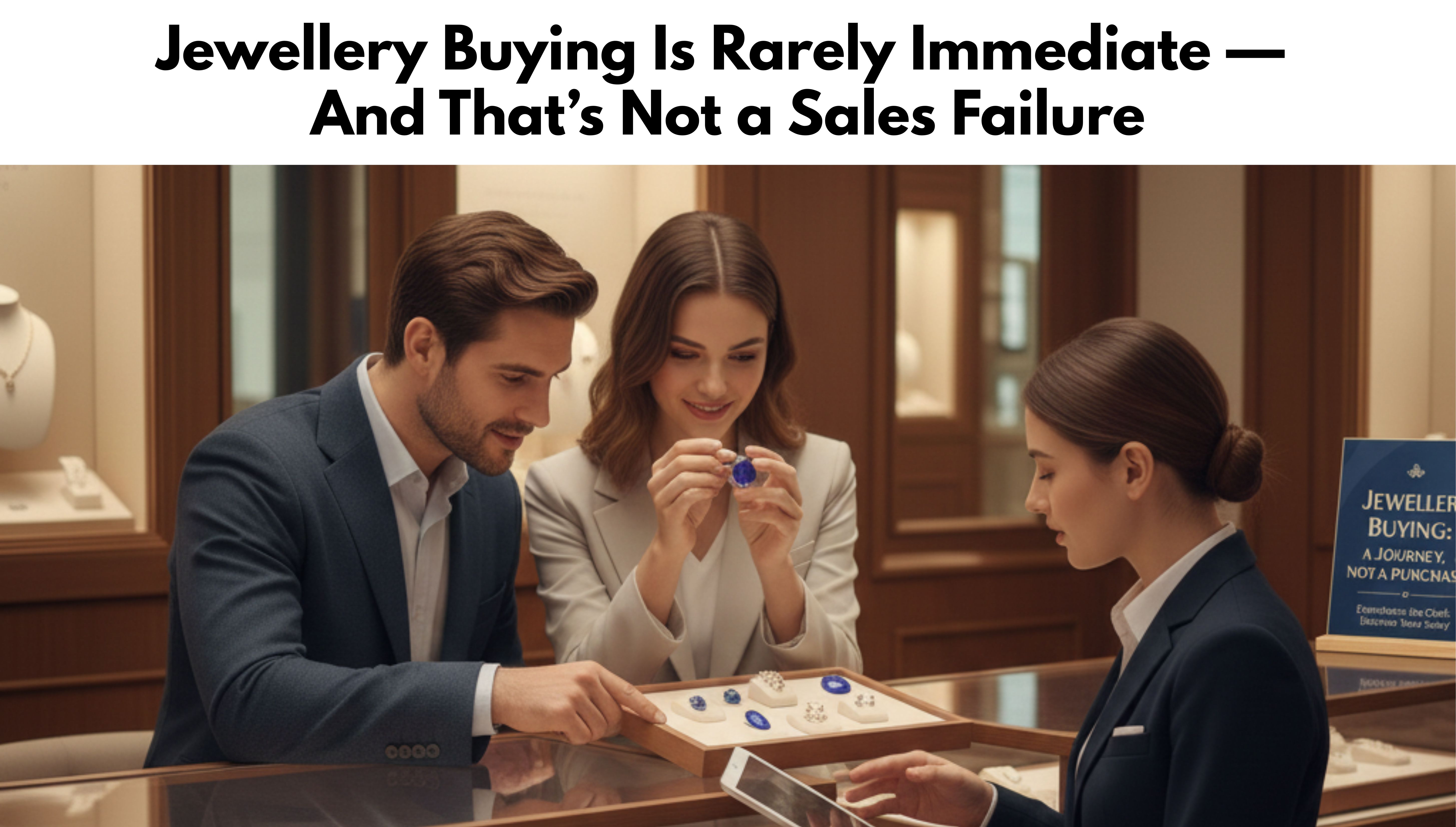
Jewellery buying has never been impulsive. Across changing price cycles, evolving consumer behaviour, and shifting design trends, one pattern remains consistent: customers admire, enquire, compare — and then pause. Not in rejection, but in reflection.
In the jewellery category, hesitation is not a breakdown in selling. It is a structural feature of the product itself.
Unlike most retail categories, jewellery operates at the intersection of emotion, investment, identity, and legacy. Each purchase carries weight beyond price — socially, symbolically, and psychologically. Jewellery is not consumed and discarded; it is retained, revisited, photographed, inherited, and remembered. This permanence fundamentally alters buying behaviour.
When a customer stands at the counter, the decision is rarely limited to design or budget. It includes questions of timing, relevance, lifestyle fit, family expectations, and long-term wearability. The internal question is not “Is this beautiful?” but “Does this belong in my life right now?”
This distinction explains why admiration and readiness often exist separately. A diamond bracelet may be admired but postponed because it feels misaligned with daily life. A gold chain may be delayed due to unresolved family preferences. A self-purchase may be deferred — not because of cost, but because emotional justification has not settled. In such cases, the jewellery is not lacking. The moment is.
As the industry has evolved, transparency, customisation, and variety have strengthened credibility. However, they have also introduced complexity. Grams, diamond grades, pricing slabs, certification layers, and design variations — while informative — also increase cognitive load. Jewellery decisions feel emotionally difficult to reverse, even when exchange policies exist. For many customers, postponement becomes a rational response to perceived risk.
This is particularly visible among informed, independent buyers. The more knowledgeable the customer, the more cautious the decision cycle becomes.
Jewellery purchases also rarely exist in isolation. Even when a customer visits alone, other voices remain present — family opinions, spousal preferences, cultural norms, generational expectations. Jewellery functions as a collective symbol as much as a personal one. When those voices are absent, the decision often feels incomplete.
For the trade, this shift requires a fundamental reframing. Jewellery selling is not about accelerating decisions. It is about stabilising them.
The counter is not a closing point. It is a decision-support space. Successful retailers are moving away from “How do we convert today?” toward “What does this customer need to feel aligned?”
This shift begins with restraint. When customers sense urgency, they slow down. When they sense permission — to pause, reflect, and return — the decision becomes easier. Presence without pressure signals confidence in both product and relationship.
Clarity, meanwhile, does not come from adding more information. It comes from reducing friction. For retailers, this means curated presentation over excessive choice, contextual explanation rather than technical overload, and clear positioning instead of constant comparison.
For manufacturers, this means designing collections with internal coherence, avoiding unnecessary variations, and supporting retailers with narratives — not just specifications. The goal is not to impress customers with knowledge, but to help them arrive at certainty.
Trust, in jewellery, precedes purchase — and often outlasts it. It is built when pricing is explained rather than defended, when time is respected rather than exploited, and when follow-up feels invitational rather than transactional. This trust may not convert instantly, but when it does, the decision is rarely tentative.
The most mature players understand a critical distinction: sales are closed through urgency, but decisions are completed through clarity. Jewellery performs best when it meets customers at the moment of readiness. That readiness cannot be forced — but it can be supported through consistent design language, familiar silhouettes, and pieces that adapt across occasions.
When customers admire jewellery but do not buy, it is tempting to see the moment as a missed opportunity. With experience, one learns to see it differently. Often, it is a sign that the jewellery has done its job — provoked thought, stirred emotion, demanded consideration.
In a category defined by permanence and meaning, patience is not passive. It is strategic. Jewellery does not sell best when rushed. It sells best when the decision feels inevitable.



Be the first to comment