


Jewellery retail is shifting from event-based transactions to long-term customer relationships. As buying behaviour evolves, repeat customers are emerging as the most reliable drivers of profitability, stability and sustained growth for retailers.
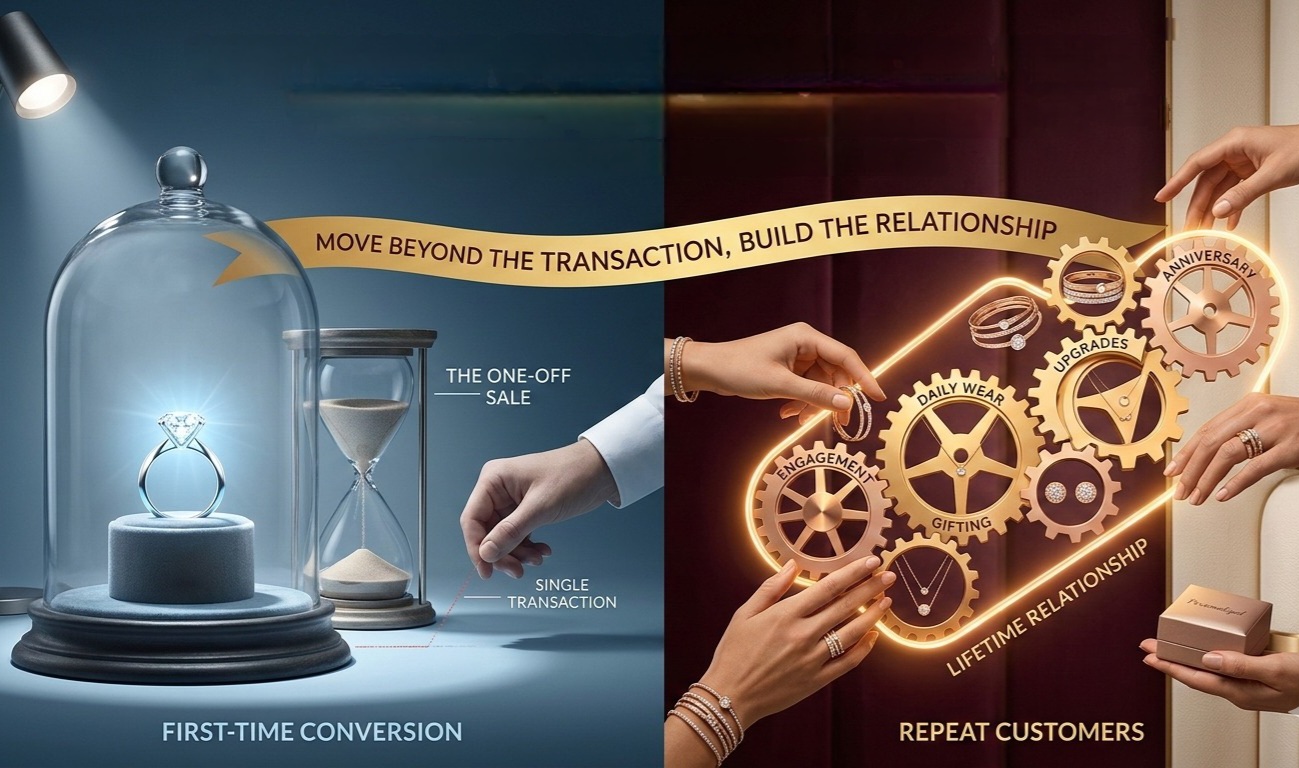
For decades, success in jewellery retail was measured by a single defining moment: the conversion. Turning a walk-in customer into a buyer — often after extensive discussion, comparison, and family consultation — was considered the ultimate achievement.
Given the high value and emotional nature of jewellery purchases, this approach was logical. Retailers focused on closing the sale because each transaction carried significant revenue potential.
However, the structure of jewellery retail has evolved considerably.
While first-time conversions remain important, they no longer determine long-term success on their own. In a market shaped by rising gold prices, lightweight jewellery, rapid design cycles, and increasingly informed consumers, repeat customers are becoming the most reliable source of growth and stability.
For experienced retailers, this shift is not philosophical—it is commercial.
Traditionally, jewellery buying was tied to major life events. Weddings, anniversaries, festivals, and inheritance cycles dictated demand, and customers often visited a jewellery store only occasionally.
Today, the purchasing landscape has broadened significantly.
Customers are increasingly engaging with jewellery in everyday contexts. Daily-wear jewellery, office accessories, milestone self-purchases, and gifting beyond traditional festivals have become common reasons to buy. Instead of making one large purchase every few years, consumers are now more likely to buy jewellery gradually and across multiple occasions.
This change has transformed jewellery retail from a series of isolated transactions into an ongoing relationship business.
Retailers who fail to adapt to this reality risk becoming relevant only during peak buying seasons, while those who nurture long-term customer relationships benefit from consistent engagement throughout the year.
First-time customers remain essential because they bring new buyers into the business. Yet they are also the most expensive customers to acquire and serve.
Converting a first-time buyer typically requires higher marketing investment, longer selling time, and greater involvement from sales staff. New customers are often more price sensitive, more likely to compare multiple stores, and more inclined to negotiate before making a purchase.
Although the resulting sale may generate significant revenue, the economics remain uncertain unless the customer returns for future purchases. Without repeat engagement, the long-term value of that conversion remains limited.
Higher lifetime value
Repeat customers rarely make just one additional purchase. Over time, they tend to buy across multiple categories—from daily wear and gifting pieces to upgrades and bridal additions.
Even when individual purchases are smaller, the cumulative value generated over several years can be substantial. In many mature jewellery businesses, a relatively small group of repeat customers contributes a disproportionately large share of annual revenue.
Faster, more efficient sales cycles
Selling to a repeat customer is operationally more efficient. Established customers already trust the retailer’s quality standards, pricing transparency, and service.
As a result, purchase decisions are made faster, sales conversations become more focused, and customers are more open to recommendations or new collections. This improves staff productivity and reduces the pressure to rely on aggressive selling techniques.
Greater revenue stability
Repeat purchasing behaviour introduces predictability into the business. Instead of relying primarily on occasional high-value sales, retailers benefit from steady movement of lightweight and mid-ticket jewellery.
This consistent activity helps maintain revenue flow between peak seasons while also improving inventory planning and working capital management.
Stronger brand loyalty
Repeat customers also act as a competitive advantage. Having built trust over multiple transactions, they are less likely to shift stores due to minor price differences or promotional offers elsewhere.
In many cases, loyal customers also become advocates for the brand, recommending the retailer to family members and friends. This form of trust-based referral is extremely difficult for competitors to replicate.
One of the biggest shifts in jewellery retail has been the rapid growth of lightweight jewellery.
These pieces typically involve lower entry prices, making them more accessible for frequent purchases. Customers often buy them for everyday wear or as additions to existing collections.
However, the full potential of this category emerges only when customers return regularly. A retailer focused purely on first-time conversions captures only a fraction of the opportunity, whereas repeat customers drive the sustained demand that keeps lightweight collections moving.
Even experienced retailers sometimes unintentionally limit repeat behaviour.
In many stores, each sale is treated as a standalone transaction rather than part of a longer relationship. Designs may be sold without continuity or future linkage, and customer engagement often ends once billing is complete.
Retailers may also rely excessively on promotional discounts to encourage repeat visits, which can weaken long-term brand value.
These approaches can deliver transactions—but they rarely build loyalty.
Selling with a long-term perspective
Retailers who successfully encourage repeat purchases position jewellery as part of an evolving collection rather than a one-time purchase.
They introduce coordinated collections instead of isolated pieces and recommend designs that complement or build upon previous purchases. By framing each purchase as part of a larger journey, they naturally create reasons for customers to return.
Expanding the role of the sales team
In repeat-driven retail, sales professionals function more like relationship managers.
Remembering customer preferences, tracking previous purchases, and suggesting upgrades or complementary designs helps build continuity across visits. These personal connections strengthen trust and encourage long-term engagement.
Creating structured reasons to revisit
Repeat visits rarely occur by chance—they are designed.
Retailers encourage return visits through regular introduction of lightweight collections, visual refreshes within the store, and personalised communication around gifting occasions, anniversaries, or potential upgrades.
Design continuity also plays an important role, allowing customers to gradually build a cohesive jewellery wardrobe over time.
A common misconception in jewellery retail is that repeat purchases must be driven by discounts.
In reality, excessive discounting can train customers to delay purchases while permanently compressing margins. It also tends to attract price-driven buyers rather than relationship-driven customers.
Instead, many retailers are shifting toward value-based retention strategies such as offering early access to new designs, personalised previews, priority service, and flexible upgrade or exchange options.
These approaches strengthen loyalty while protecting brand positioning.
Experienced jewellers often rely on intuition and long-term customer familiarity, and these instincts remain valuable.
However, modern retail increasingly benefits from structured insights alongside experience. Tracking purchase history, understanding buying cycles, identifying dormant customers, and segmenting customers by behaviour rather than demographics can significantly strengthen repeat-purchase strategies.
The objective is not automation for its own sake, but consistency in maintaining customer relationships.
Jewellery retail today operates in an environment of rising input costs, intense competition, and highly informed consumers. In such conditions, growth is no longer driven solely by footfall or occasional high-value conversions.
Repeat customers have become a strategic asset.
They reduce acquisition costs, stabilise revenue, improve inventory turnover, protect margins, and strengthen long-term business value.
First-time conversions will always remain important—they introduce new customers to the brand.
But repeat customers are what sustain the business.
Retailers who intentionally design their strategies around repeat engagement are likely to define the next phase of jewellery retail growth. Those who continue to rely primarily on one-time sales may remain operational—but scaling the business will become increasingly difficult.
In today’s jewellery market, the strongest retail businesses are built not on transactions, but on customers who return.


Be the first to comment